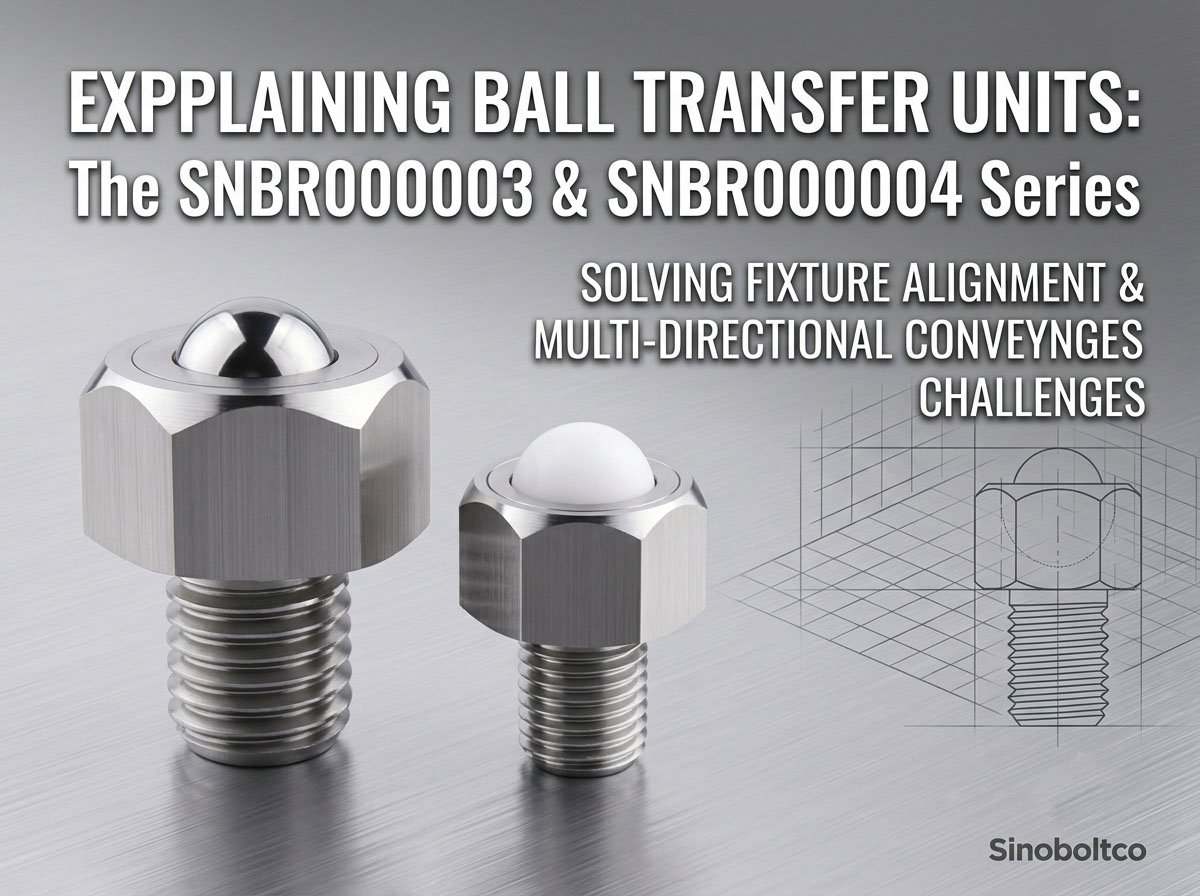
Friction is the quiet cost center on every production floor. On packaging lines, assembly stations, and precision fixtures, every extra ounce of drag between a part and its supporting surface translates into wasted motion, added cycle time, and operator fatigue. For engineers designing fixture alignment solutions that need parts to move freely in any direction — not just forward and back — the ball transfer unit is one of the most underrated components on the BOM.
This guide breaks down the engineering behind Sinoboltco’s SNBR000003 / SNBR000004 ball transfer units and how to specify the right one for your application.
What Is a Ball Transfer Unit?
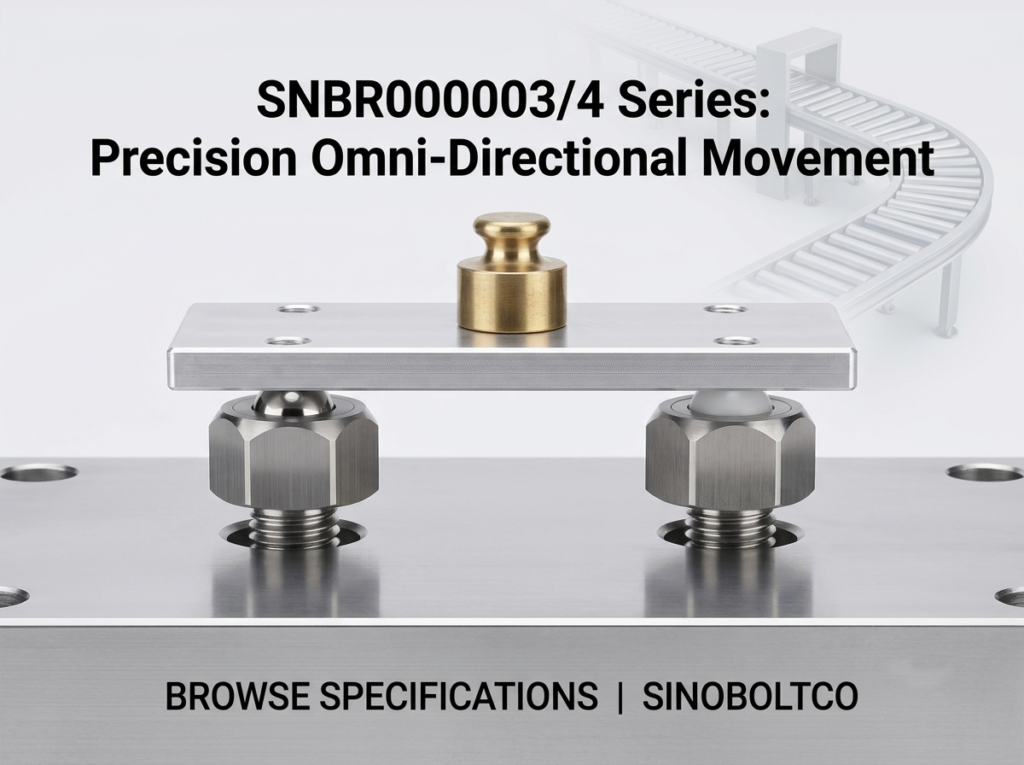
A ball transfer unit (also called a ball roller, ball caster, or transfer ball) replaces a conventional roller with a free-floating main ball supported by a bed of smaller sub-balls. Instead of rotating around a single fixed axis like a conveyor roller, the main ball can rotate in any direction on its X-Y plane, giving parts true omnidirectional movement across a flat surface.
This makes them a go-to component for:
- Fixture alignment solutions — allowing a workpiece to self-center or be nudged into position without binding
- Multi-directional conveying and transfer tables
- Assembly line side-loading and 90° part redirection
- Load-bearing turntables and inspection stations
The Mechanics of 360° Movement
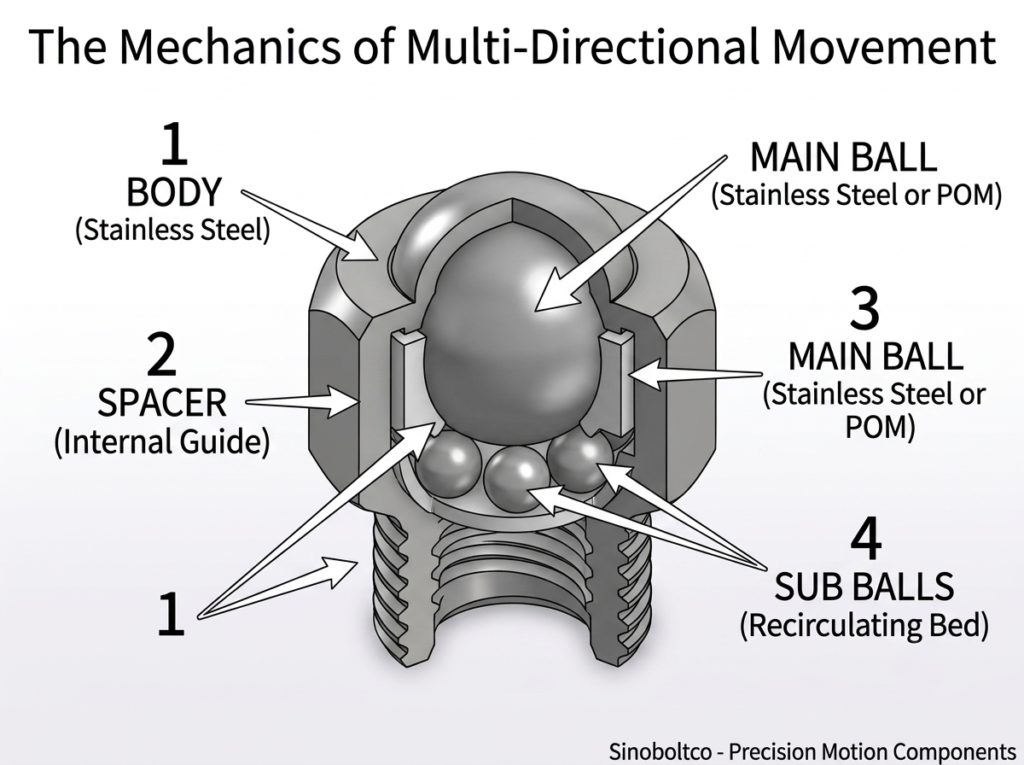
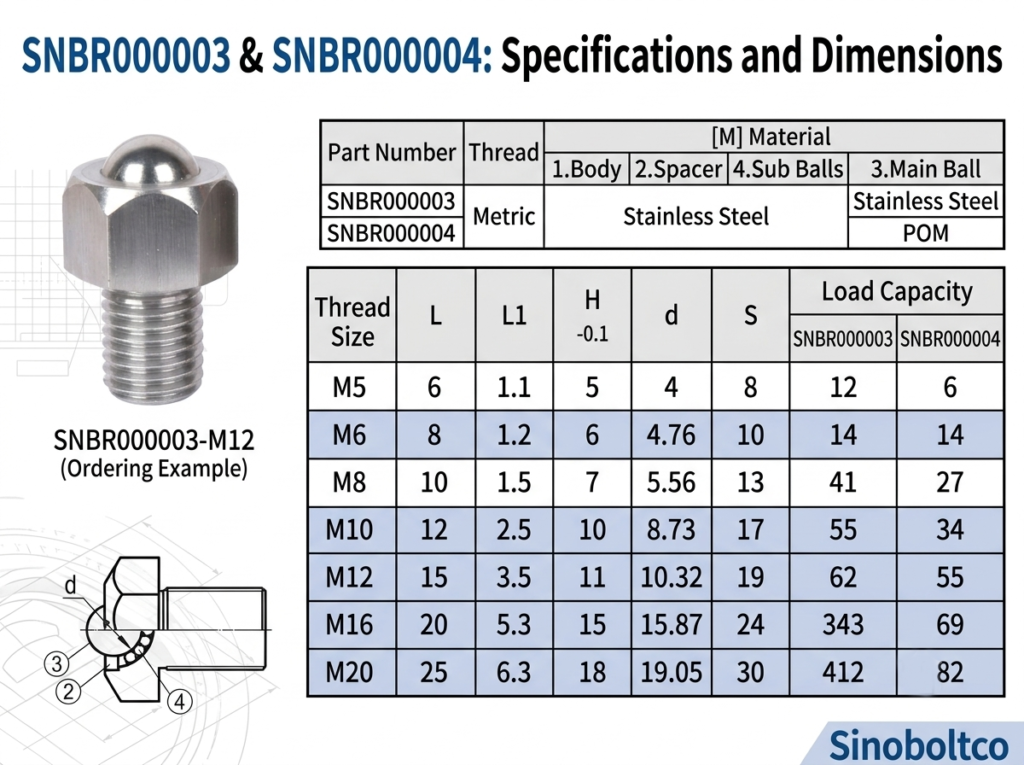
The SNBR000003/4 series uses a “large ball on small balls” design (body, spacer, sub-balls, and main ball working together — see cross-section diagram below). Load is distributed across multiple sub-ball contact points rather than concentrated on a single bearing race, which:
- Spreads point-loading across the housing, reducing localized wear
- Keeps rolling resistance low even under lateral load
- Allows the main ball to respond instantly to directional changes — critical for fixture alignment where a part may need to shift a few millimeters in an unpredictable direction
Material Selection: Stainless Steel vs. POM
Choosing the right main-ball material is the single biggest factor in service life and application fit:
| Material | Series | Best For |
|---|---|---|
| Stainless Steel | SNBR000003 | Higher load capacity, corrosion resistance, washdown/outdoor environments, heavier fixtures |
| POM (Polyoxymethylene) | SNBR000004 | Self-lubricating, quieter operation, safe contact for delicate or cosmetic-sensitive parts |
Both series share a stainless steel body and spacer, so the difference comes down to matching main-ball material to your load and part-contact requirements.
Sizing and Load Capacity Reference
| Thread (M) | L (mm) | L1 (mm) | H (mm) | d (mm) | S (mm) | Load — SNBR000003 (N) | Load — SNBR000004 (N) |
|---|---|---|---|---|---|---|---|
| M5 | 6 | 1.1 | 5 | 4 | 8 | 12 | 6 |
| M6 | 8 | 1.2 | 6 | 4.76 | 10 | 14 | 14 |
| M8 | 10 | 1.5 | 7 | 5.56 | 13 | 41 | 27 |
| M10 | 12 | 2.5 | 10 | 8.73 | 17 | 55 | 34 |
| M12 | 15 | 3.5 | 11 | 10.32 | 19 | 62 | 55 |
| M16 | 20 | 5.3 | 15 | 15.87 | 24 | 343 | 69 |
| M20 | 25 | 6.3 | 18 | 19.05 | 30 | 412 | 82 |
Ordering example: SNBR000003-M12
For heavier fixtures or higher-throughput lines, sizing up to M12–M20 gives a wider mounting base and meaningfully higher load tolerance — worth the extra footprint if your application runs near the top of its duty cycle.
Installation Best Practices
- Mount on a level, rigid surface — uneven mounting is the most common cause of premature wear on ball transfer units
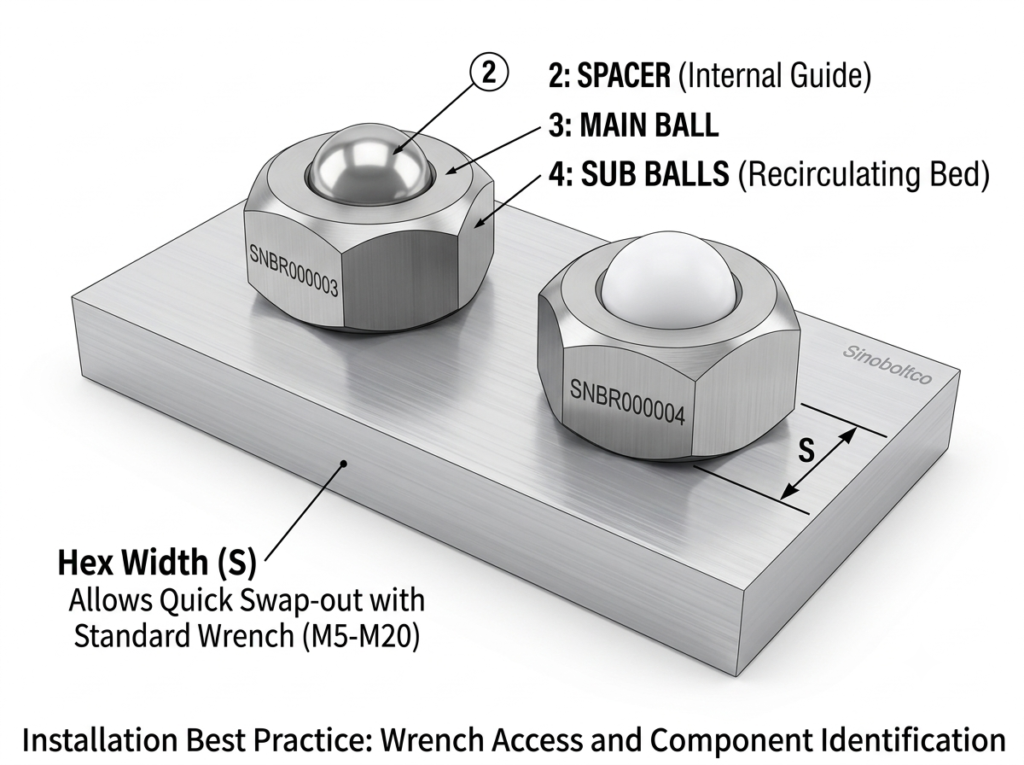
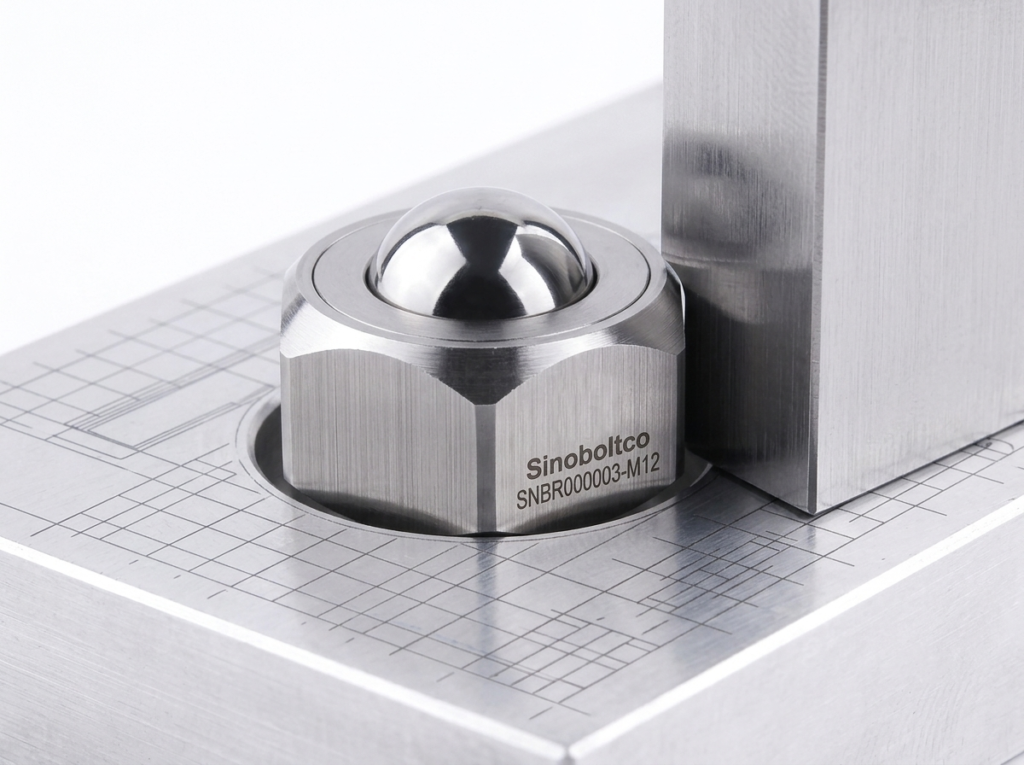
- The hex head allows quick swap-out with a standard wrench during routine maintenance, minimizing line downtime
- For fixture alignment applications, space units to support the part’s center of gravity at all points of travel, not just at rest
Why It Matters for Your Line
Specifying the right ball transfer unit isn’t just a hardware choice — it directly affects operator fatigue, cycle time, and how cleanly parts index into position on a fixture. Getting the material and load rating right the first time avoids costly mid-run swaps.
Browse the full SNBR000003 / SNBR000004 specification and request a quote at Sinoboltco — or reach out to our engineering team for help matching a ball transfer unit to your specific fixture alignment or conveying application.