
In the world of industrial fasteners, efficiency often rivals strength in importance. Whether you are securing equipment on a high-seas vessel or calibrating a precision production line, the ability to lock and release components instantly is a game-changer.
This guide explores the technical nuances of Stainless Steel Quick Release Pull Ring Pins and why they are becoming the standard for modern engineering.
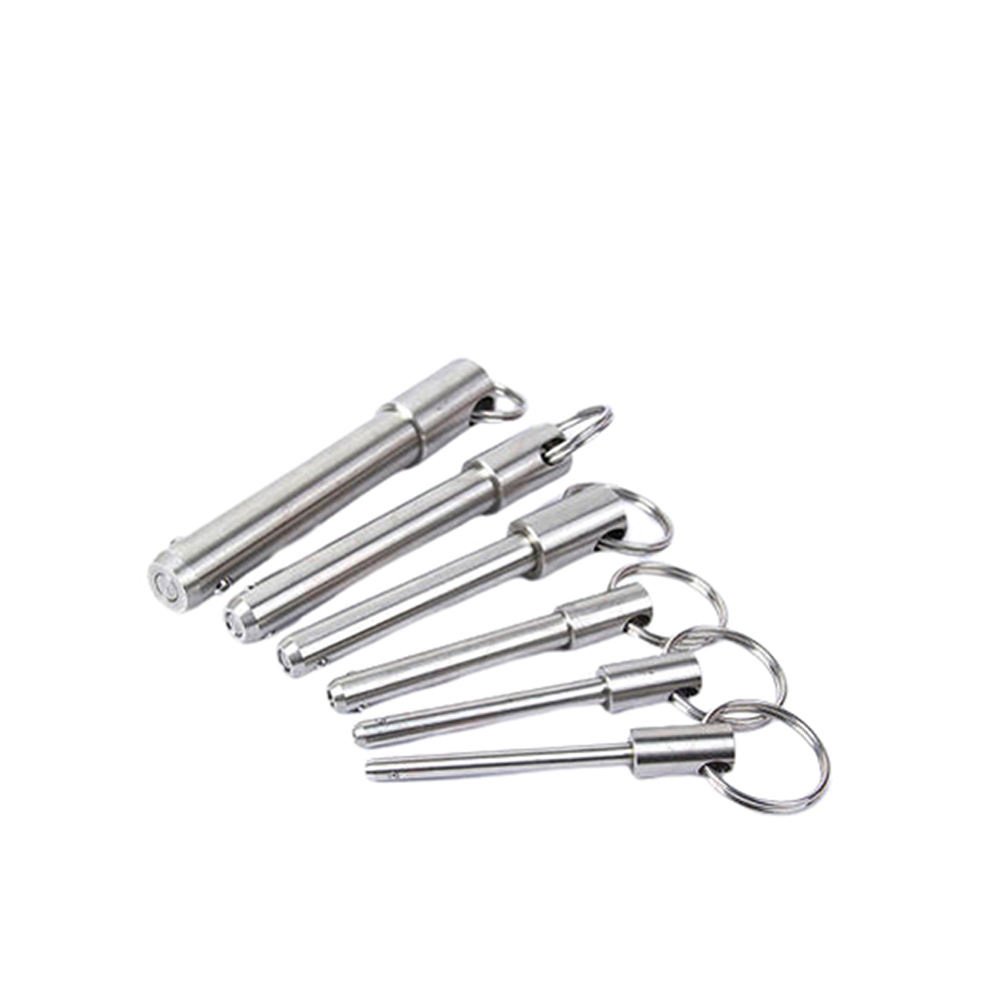
1. What Makes a “Quick Release” Pin Different?
Unlike standard bolts or clevis pins that require tools or cotter pins for secondary securing, a Quick Release Detent Pin utilizes an internal spring mechanism.
The Mechanism: A spring-loaded ball protrudes from the shank, acting as a “stop.”
The Operation: When the pin is pushed into a hole, the ball retracts and then snaps back out once clear, locking the pin in place. To remove, simply pull the ring—no wrenches, no fuss.
2. Material Matters: Why Stainless Steel is Non-Negotiable
For many of our clients in the maritime and chemical industries, carbon steel simply doesn’t cut it. We focus on two primary grades:
SUS304: Excellent for general industrial use, providing high strength and good corrosion resistance in freshwater or indoor environments.
SUS316: The “Marine Grade.” With the addition of molybdenum, SUS316 pins offer superior resistance to chlorides (seawater) and acidic environments.
Technical Tip: Always verify that the internal spring and detent ball are also made of stainless steel. Some low-cost suppliers use carbon steel springs, which lead to internal rusting and mechanism failure in humid conditions.
3. Key Design Feature: The Pull Ring & Shoulder
Why choose a Pull Ring over a T-handle or Button-head?
Lanyard Compatibility: The ring is the perfect attachment point for a safety lanyard. In offshore or high-altitude work, a dropped pin isn’t just an inconvenience—it’s a safety hazard.
Compact Profile: Pull rings offer a lower profile than bulky handles, making them ideal for tight spaces in machinery.
The Shoulder Advantage: A shouldered design (the flange at the top) ensures the pin stops at a precise depth every time, providing consistent shear strength and stability.
4. How to Measure and Select the Right Size
Choosing the wrong size can lead to mechanical play or failure. Referencing our standard technical tables, you must consider:
Diameter (A): Should be slightly smaller than your hole size. Our pins are precision-ground with a tight tolerance (typically -0.04 / -0.08mm) to ensure a snug fit.
Effective Length (L): This is the distance from the shoulder to the start of the detent ball. Your workpiece thickness should match this length as closely as possible to prevent rattling.
5. Common Industry Applications
Maritime: Securing sail riggings, deck hardware, and removable seating.
Automation: Quick-change fixtures on robotic arms and assembly lines.
Fitness Equipment: Weight stack adjustments and foldable frames.
Stage Lighting: Securing truss sections and heavy audio arrays.
Conclusion
Investing in high-quality quick-release hardware is an investment in operational uptime. By eliminating the need for tools and ensuring corrosion resistance, you reduce maintenance cycles and improve site safety.
Looking for a custom size or high-volume manufacturing? we specialize in high-precision stainless steel fasteners tailored to your technical drawings.