
In modern material handling and precision engineering, the choice of components can make or break system efficiency. Among the most versatile yet overlooked fasteners are Hex Head Ball Transfer Units. When your application demands smooth, omnidirectional movement in sensitive environments, choosing between POM (Polyoxymethylene) and PEEK (Polyetheretherketone) is the first critical decision.
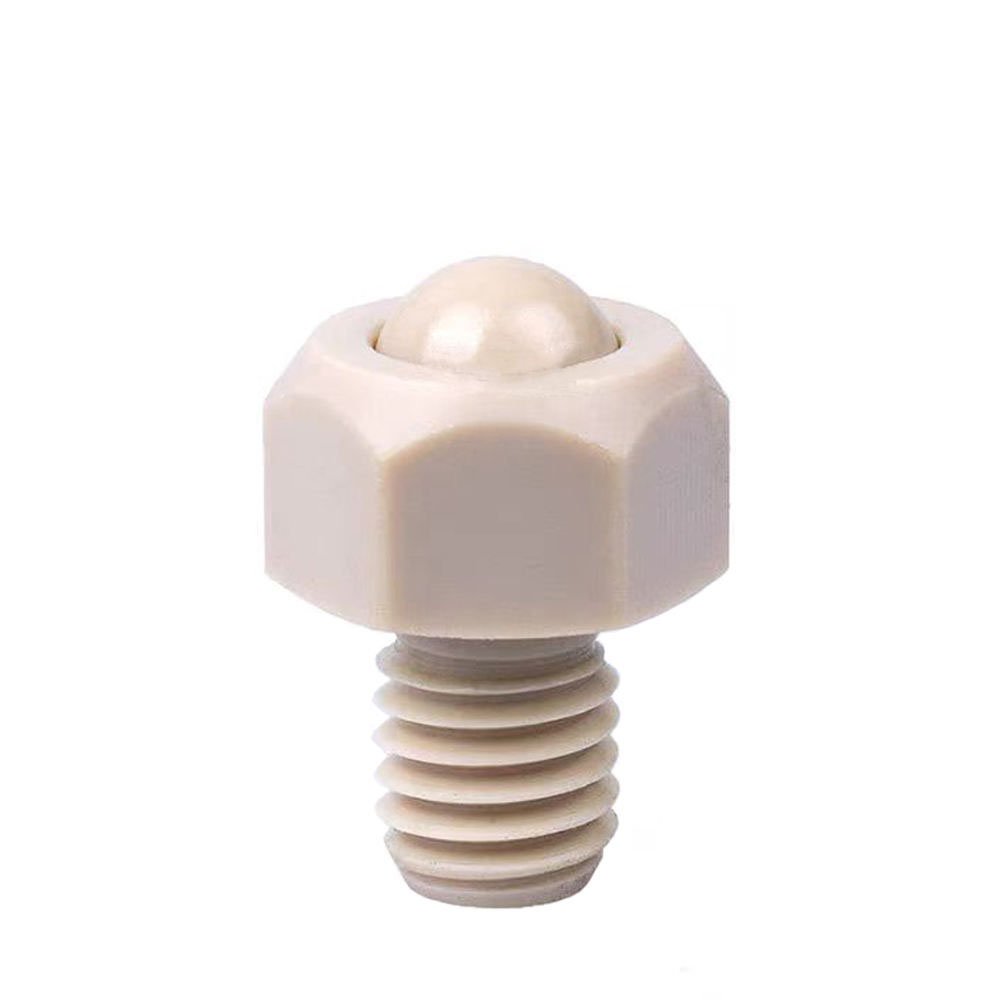
Understanding the Mechanics of Ball Plunger Units
A ball transfer unit (or ball plunger) is a multi-directional load-bearing roller. The design features a large primary ball sitting on a bed of smaller stainless steel sub-balls, all encased in a threaded housing. The hexagonal head allows for precise torque application during installation, ensuring the unit remains secure under vibration.
Material Showdown: When to Choose POM vs. PEEK
1. POM (Acetal) – The Industrial Workhorse
POM is a high-grade engineering thermoplastic known for its high stiffness and low friction.
Best For: Standard conveyor lines, furniture, and general warehouse automation.
Key Advantage: Exceptional toughness and cost-effectiveness for high-volume applications.
Technical Limit: Suitable for moderate temperatures and standard chemical exposure.
2. PEEK – The Extreme Environment Specialist
PEEK is a premium “super-plastic” used in aerospace and medical sectors.
Best For: Semiconductor manufacturing, food processing, and chemical laboratories.
Key Advantage: Incredible thermal stability and resistance to aggressive cleaning agents or chemicals.
Surface Protection: Unlike metal rollers, PEEK balls will not scratch or mar delicate workpieces like glass or polished aluminum.
Technical Specification Overview
When integrating these units into your design, pay close attention to the following dimensions to ensure compatibility with your existing hardware:
| Spec | Description | Importance |
| M | Thread Size (M5-M10) | Determines the mounting hole size. |
| d | Ball Diameter | Higher diameter usually correlates to higher load capacity. |
| E | Hex Head Height | Crucial for clearance in tight mechanical assemblies. |
Installation Pro-Tips for Engineers
Thread Engagement: Ensure the thread length (L) matches your mounting plate thickness for maximum stability.
Orientation: While these are omnidirectional, installing them in a staggered pattern on a conveyor bed provides the most stable support for uneven loads.
Maintenance: Thanks to the self-lubricating properties of POM and PEEK, these units require significantly less greasing than all-metal alternatives.
Conclusion
Selecting the right material for your ball transfer units isn’t just about price—it’s about the longevity of your system. For most light-to-medium industrial needs, POM is an excellent choice. However, if you are operating in high-heat or sterile environments, the investment in PEEK will pay for itself in reduced downtime.
Looking for precision-grade fasteners? Explore our full range of PEEK and POM high-performance components at sinoboltco.com. We specialize in providing the “rolling edge” your machinery needs.