
Spring pins—also known as slotted spring pins, coiled spring pins, or spring dowel pins—are widely used in mechanical assemblies that require precise alignment, vibration resistance, and reliable fastening.
This SEO-optimized technical guide from Sinoboltco explains the types of spring pins, material selection, technical specifications, and how to choose the correct spring pin for your application.
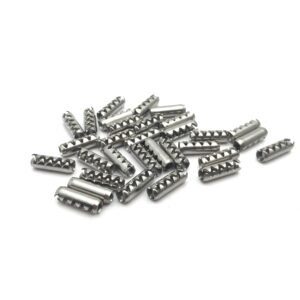
What Are Spring Pins? (Definition & Function)
A spring pin is an elastic cylindrical fastener designed to be pressed into a hole smaller than its nominal diameter. When inserted, the pin compresses and creates a constant radial force, improving:
Component alignment
Vibration resistance
Shear strength
Assembly stability
Types of Spring Pins
The two most common types are:
Slotted Spring Pins (DIN 1481 / ISO 8752)
Single longitudinal slot
High elasticity
Suitable for medium-to-heavy load fastening
Cost-effective and easy to install
Coiled Spring Pins (ISO 13337)
Multi-coil construction
Excellent shock absorption
Even stress distribution
Best choice for applications with vibration and dynamic loads
Technical Specifications and Engineering Considerations
Engineers choosing spring pins must evaluate material, hardness, hole tolerance, and expected mechanical load.
Material Selection
| Material | Benefits | Suitable Environments |
|---|---|---|
| High-Carbon Steel | Strong & economical | General machinery |
| Alloy Steel | Superior fatigue resistance | Impact & heavy load |
| Stainless Steel 304/316 | Corrosion-resistant | Outdoor, marine, moisture environments |
| Spring Steel | Maximum elasticity | Tools, shafts, hinges |
Sinoboltco offers customized material solutions based on shear strength, fatigue life, and environmental exposure.
Dimensional Tolerance (Critical for Performance)
To ensure proper compression and holding force:
Recommended hole tolerance: H11–H12
Chamfered hole edges improve assembly
Pin outer diameter tolerance: ±0.01 mm (Sinoboltco custom spec)
Incorrect hole sizing may lead to pin deformation, failure, or reduced fatigue resistance.
Shear Strength & Load Capacity
Spring pins primarily carry double shear loads. Performance depends on:
Wall thickness
Slot or coil design
Material hardness
Diameter relative to hole size
Coiled spring pins offer superior durability for dynamic assemblies such as motors, gears, and rotating mechanisms.
Slotted vs. Coiled Spring Pins — Which Should You Choose?
Choose Slotted Spring Pins When:
You need a cost-effective fastening solution
The load is stable without intense vibration
You require simple and fast installation
The assembly environment is moderate
Typical applications:
General machinery, agricultural equipment, hinge assemblies, hardware tools
Choose Coiled Spring Pins When:
High vibration or impact load is expected
Fatigue life is a priority
You need consistent shear performance
Precision alignment is required
Typical applications:
Power tools, automotive components, electric motors, robotic arms
Surface Finishes and Corrosion Protection
Different environments require different protective coatings.
| Finish | Benefits | Typical Use |
|---|---|---|
| Black Oxide | Basic corrosion resistance | Indoor machinery |
| Zinc Plated | Cost-effective protection | Hardware & equipment |
| Nickel Plated | High wear resistance | Electronics & appliances |
| Phosphate | Enhanced lubrication | Automotive |
| Stainless Steel Passivation | Superior corrosion resistance | Marine & outdoor |
Sinoboltco supports custom coating solutions for harsh environments.
Installation Recommendations for Better Performance
Hole Preparation
Maintain correct tolerances
Remove burrs
Ensure smooth entry chamfer
Assembly Methods
Use a press machine for precision
Avoid hammering (may deform pins)
For automated assembly, use tapered-entry coiled pins
Sinoboltco provides engineering support for hole size and installation methods.
Why Choose Sinoboltco for Spring Pins Manufacturing?
OEM/ODM customization service
DIN, ISO, ANSI, JIS compliant
Advanced cold-forming technology
100% quality inspection (hardness, dimensions, shear load)
Global export experience to 40+ countries
Sinoboltco ensures consistent quality for high-volume industrial projects.
Quick Selection Checklist for Engineers
Before choosing your spring pin, confirm:
 Load condition (static or dynamic) Required fatigue life Operating environment (humidity, corrosion, chemicals) Hole tolerance Vibration level Required diameter & length options Standard or customized specification Surface coating requirements
Contact Sinoboltco for Technical Support or a Quotation
For custom spring pin solutions, drawings, or engineering recommendations:
 Email: sinoboltcompany@sinoboltco.com
 Website: sinoboltco.com
 OEM & ODM Projects Welcome
Spring pins—also called slotted spring pins and coiled spring pins—are widely used in mechanical assemblies. For detailed technical specifications, refer to the official ISO 13337 coiled spring pin standard.
Material properties play a crucial role in pin performance. You can check high-strength steel and stainless steel properties at MatWeb Material Database.
For a comprehensive guide on mechanical fasteners, including spring pins, see Engineering Toolbox – Pins & Fasteners.
Understanding proper hole tolerances and installation methods is essential. Refer to Machine Design – Fasteners & Pins for detailed engineering guidance.
For additional reference on ISO standards related to spring pins and dowel pins, you can also visit ISO Standards Library.